
Master Sampling in Jewelry OEM Work: 25–30 Days
Twenty-five to thirty days is how long a master sample takes, and it is the block most often underestimated in a jewellery OEM schedule. It covers five bench operations, and it ends with the piece your whole production run will be measured against. Production then adds 3–4 weeks, and only 48 hours of that timeline is CAD work, according to the figures the manufacturer publishes on its own site.
Key takeaways
- Master sampling is published at 25–30 days and covers five operations in sequence.
- The window ends with an approved physical master, which becomes the reference for every later batch.
- CAD work takes under 48 hours, so drawing is the smallest part of the timeline.
- Production after approval adds a further 3–4 weeks, and minimums are 50 / 100 / 100+ pieces per design by material.
What the 25–30 day figure buys
The published sampling window covers the 3D wax print and mould casting, before stone-setting, gloss polishing and custom electroplating. That is not a queue; it is five distinct operations that each have to succeed on the same piece before the next one starts.
The output is a physical master. Everything about the production run - plate colour, polish level, stone position, weight - gets checked against that piece, which is why the sampling stage is worth more attention than its position on a calendar suggests.
Why the window is a range and not a number
Between the fast end and the slow end lies design complexity. A plain band needs casting, polishing and plating. A multi-stone pendant adds a setting bench and the risk of a stone shifting during the polish.
That is the reason a factory publishes 25–30 days rather than naming a date. Treat the top of the range as the planning number and the bottom as the best case.
| Stage | Published window | In days |
|---|---|---|
| 3D CAD model | under 48 hours | 2 |
| Master sampling | 25–30 days | 25–30 |
| Mass production | 3–4 weeks | 21–28 |
| Final inspection | 100% of pieces | after production |
| Minimum per design | 50 / 100 / 100+ pcs | by base material |
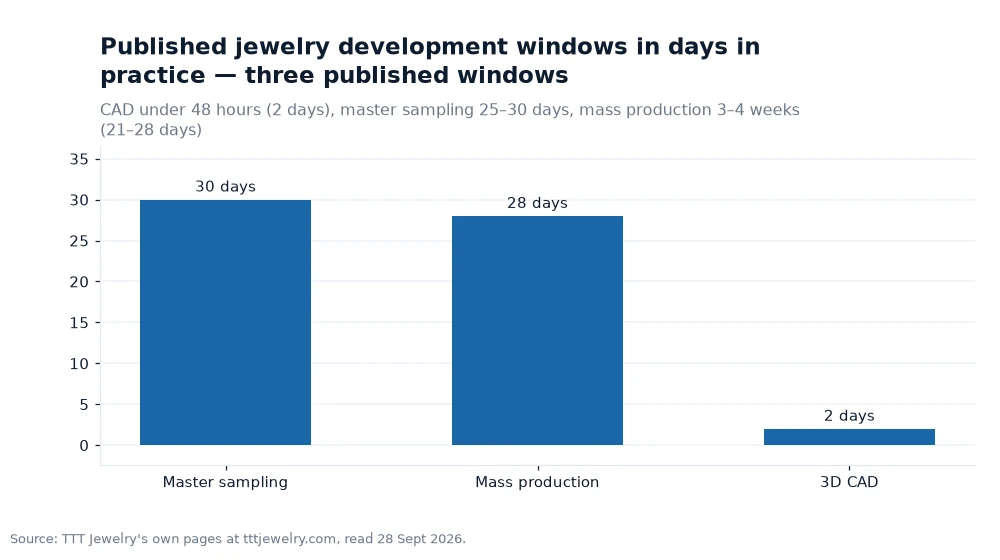
The three published windows side by side
CAD comes first at under 48 hours. Sampling follows at 25–30 days. Production comes after approval at 3–4 weeks. Nothing in the sequence overlaps except the CAD stage, which can be run across several designs at once.
Read as days, that is 2 plus 25–30 plus 21–28. The published example domain for these figures is at https://www.tttjewelry.com/oem-odm-jewelry-manufacturer/, which is where the underlying numbers come from.
Holding a batch against the master
After approval, volume production runs 3–4 weeks and finishes at a 100% inspection stage before packing. That check is where a batch is compared with the approved sample rather than with a drawing.
For the buyer, the useful habit is to keep the approved master sealed and photographed under consistent light. A reference piece in a drawer is worth more than a paragraph in a specification, especially when a reorder lands nine months after the first.
The paperwork that sits alongside the sample
Three published items travel with an order: The ISO 9001:2015 standard, an audited BSCI social-compliance programme and REACH limits on lead, cadmium and nickel in materials and plating.
None of them approves your sample. What they do is make a retail buyer's compliance checklist answerable without a second production cycle, which is often the real constraint on a launch date.
Why the first sample costs more than the second
The first order carries everything: the CAD model inside 48 hours, the wax print, the mould, the setting, the polish and the plating, then a 100% inspection before packing. The second order carries only the last part of that chain, because the tooling and the approved specification already exist.
That is the practical reason a brand should not judge a manufacturer on a pilot invoice. What looks expensive per piece in the first 25–30 days is the price of a mould that makes every later batch repeatable under ISO 9001:2015 documentation.
The four checkpoints inside a sampling cycle
Work through the window in the order the factory does. Dimensions are settled on the CAD renderings before metal is cut. Geometry is confirmed on the wax print. Colour and stone position are judged on the cast and set piece. Finish is judged after polishing and custom electroplating, which is the last operation before the master is presented for approval.
Judging finish before plating exists is impossible, and judging the plate from a render is guesswork. Each checkpoint belongs where it sits in the sequence, and each one is cheaper than the rework that follows a mis-timed sign-off.
What a buyer should send with the first brief
The published starting point is an enquiry carrying sketches, reference photos or a tech pack. All three are accepted, and all three are converted into the same 3D CAD model inside 48 hours, so the choice of format is about how well you can express the idea rather than what the factory can read.
Add four commercial fields to the brief: base material, plating, packaging and approximate quantity. Floors are 50 pcs in the silver line, 100+ pcs in stainless work and 100 in artisan brass, counted per design, so a two-design range doubles those figures.
Then state who approves what. Under the OEM/ODM process the gates are dimensions after CAD, finish after the 25–30 day sample, and packaging before the batch is packed.
Worked example: sampling as a share of the whole schedule
Convert every published window into days and add them. The CAD stage is under 48 hours, so call it 2 days. Sampling is 25–30 days as published. Production at 3–4 weeks converts to 3 × 7 = 21 and 4 × 7 = 28 days.
Fastest path: 2 + 25 + 21 = 48 days. Slowest path: 2 + 30 + 28 = 60 days.
Now express the sampling block as a share of each. At the fast end, 25 ÷ 48 = 52%. At the slow end, 30 ÷ 60 = 50%. So roughly half of a jewellery OEM timeline is the sample, and the production block takes almost all of the remainder: 21 ÷ 48 = 43.8% and 28 ÷ 60 = 46.7%.
Frequently asked questions
What happens during the 25–30 day sampling window?
Five operations in sequence: the 3D wax print, casting in a precision mould, then setting the stones, gloss polishing and custom plating, ending in a physical master sample for approval.
How long is production after sample approval?
Mass production is published at 3–4 weeks, sized by batch volume and design complexity, and it finishes with 100% inspection before branded packaging.
Which part of the timeline is the shortest?
The CAD stage, published at under 48 hours, which is about 2 days against a sampling block of 25–30 days and a production block of 21–28 days.
Treating the sample as the product
Give the sample stage as much review time as the batch it will govern, and keep the approved piece sealed once it is signed off. A collection is only as repeatable as its reference. The factory process page lists the stages that follow approval, and the silver line shows how the 50-piece minimum is tooled.
The basis for every figure above — the approved-sample benchmark, followed by CAD within 48 hours — is the company's own pages at tttjewelry.com itself, which I read on 28 Sept 2026. Nothing else here is inferred. The relative figures in the chart are my own working, and nothing else here[1].